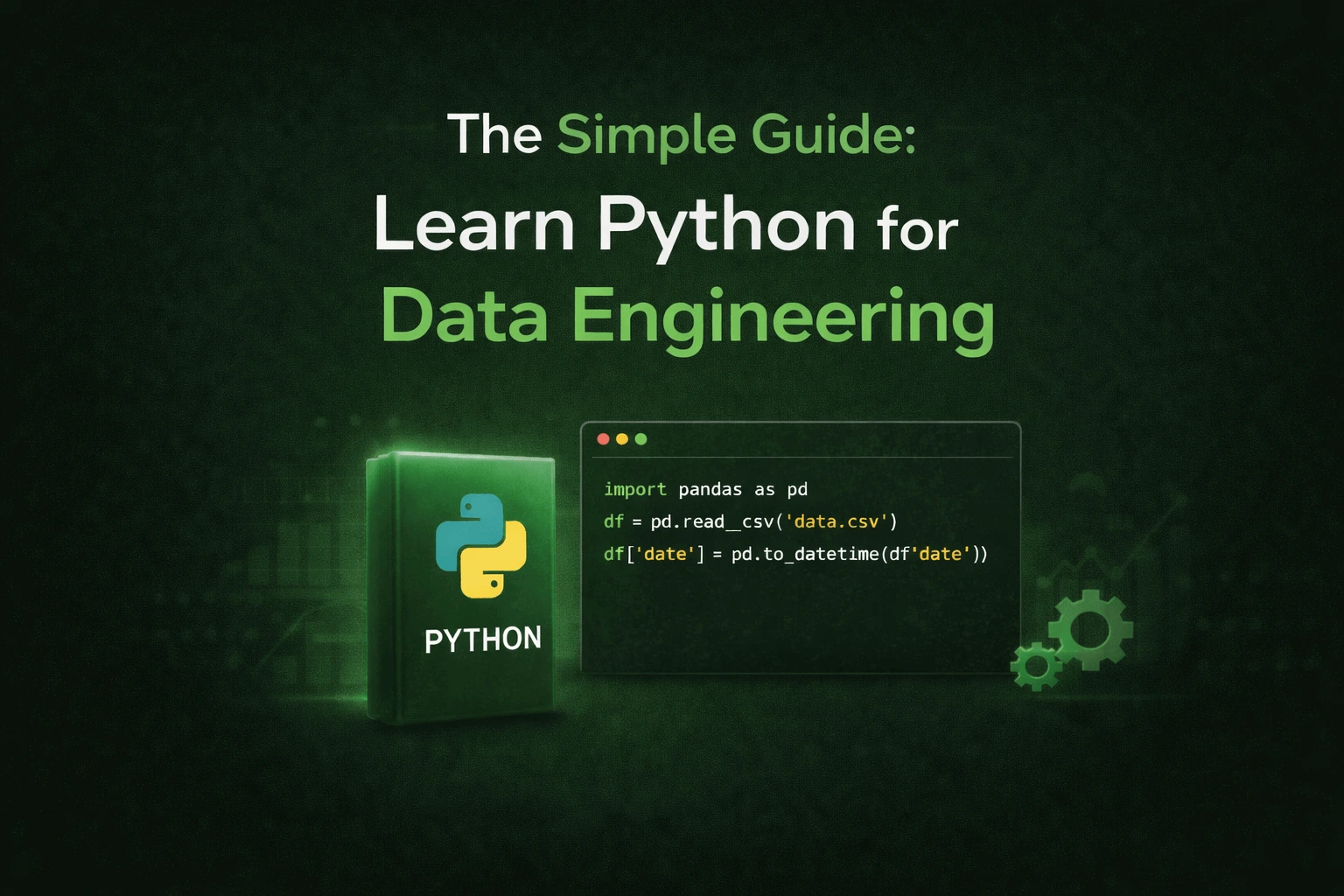
The Simple Guide: Learn Python for Data Engineering

On this page
Do not try to learn "everything." Just learn what you need to get a job.
If you are new to coding and want to become a Data Engineer, you might feel lost. There is too much information out there.
The good news? You do not need to be a software developer. You do not need to make games or websites.
To become a Data Engineer, you only need a small part of Python. You need to know how to move data from one place to another.
This guide shows you exactly what to learn.
Part 1: The Basics (Start Here)
Time needed: 1 Week
Before you can work with big data, you need to know the basics of the language.
Installation: How to install Python and VS Code (the tool used to write code).
Variables: Understanding the difference between Text (Strings), Numbers (Integers), and True/False (Booleans).
Control Flow: Using
If/Elseto make choices. UsingLoopsto repeat actions.Functions: Writing code once so you can use it again later.
Why do you need this? You cannot build a house without bricks. These are your bricks.
Part 2: Organizing Data (Data Structures)
Time needed: 1 Week
Data usually comes in two forms. You must understand them well.
Lists: How to store a list of items (like a grocery list).
Dictionaries (Very Important): How to store data with "Keys" and "Values." This is how most modern data looks (JSON).
Sets: How to remove duplicate items from a list.
Part 3: Changing Data (Pandas)
Time needed: 2 Weeks
In the real world, we do not use simple Python loops to fix data. It is too slow. We use a tool called Pandas.
DataFrames: Think of this as "Excel" inside your code.
Reading Files: How to open Excel, CSV, and JSON files with code.
Cleaning Data: How to fix empty spaces (Nulls) and fix bad formatting.
Aggregations: How to group data to find totals and averages (like SQL).
Part 4: Building the System (Engineering)
Time needed: 2 Weeks
This is the difference between a "student" and an "engineer." This part teaches you how to connect to other systems.
APIs: How to use the
requestslibrary to get data from the internet.Databases: How to use
SQLAlchemyto talk to SQL databases (like PostgreSQL).Error Handling: Using
try/exceptblocks. This stops your program from crashing if there is a small error.Logging: Stop using
print(). Use "Logging" to save a file that tells you if your code is working or failing.
The Skills Checklist
If you can check these boxes, you are ready to apply for jobs.
The Basics
[ ] I can install Python.
[ ] I know how to use Text (Strings) and Numbers (Integers).
[ ] I can write a
Function.[ ] I can write a
Loop.
Working with Data
[ ] I can open a CSV file using Pandas.
[ ] I can filter data (Example: "Show me only sales over $100").
[ ] I can fix missing data.
[ ] I can save my fixed data to a new file.
Engineering Skills
[ ] I can connect to a Database and run a query.
[ ] I can get data from an API (Internet).
[ ] I use
try/exceptto catch errors.[ ] I use
loggingto track my work.
Summary
Do not spend months watching random videos.
Focus on Pandas (for fixing data) and SQL Connectors (for moving data). If you can build a script that takes data from an API, cleans it, and puts it into a database without crashing, you are ready.