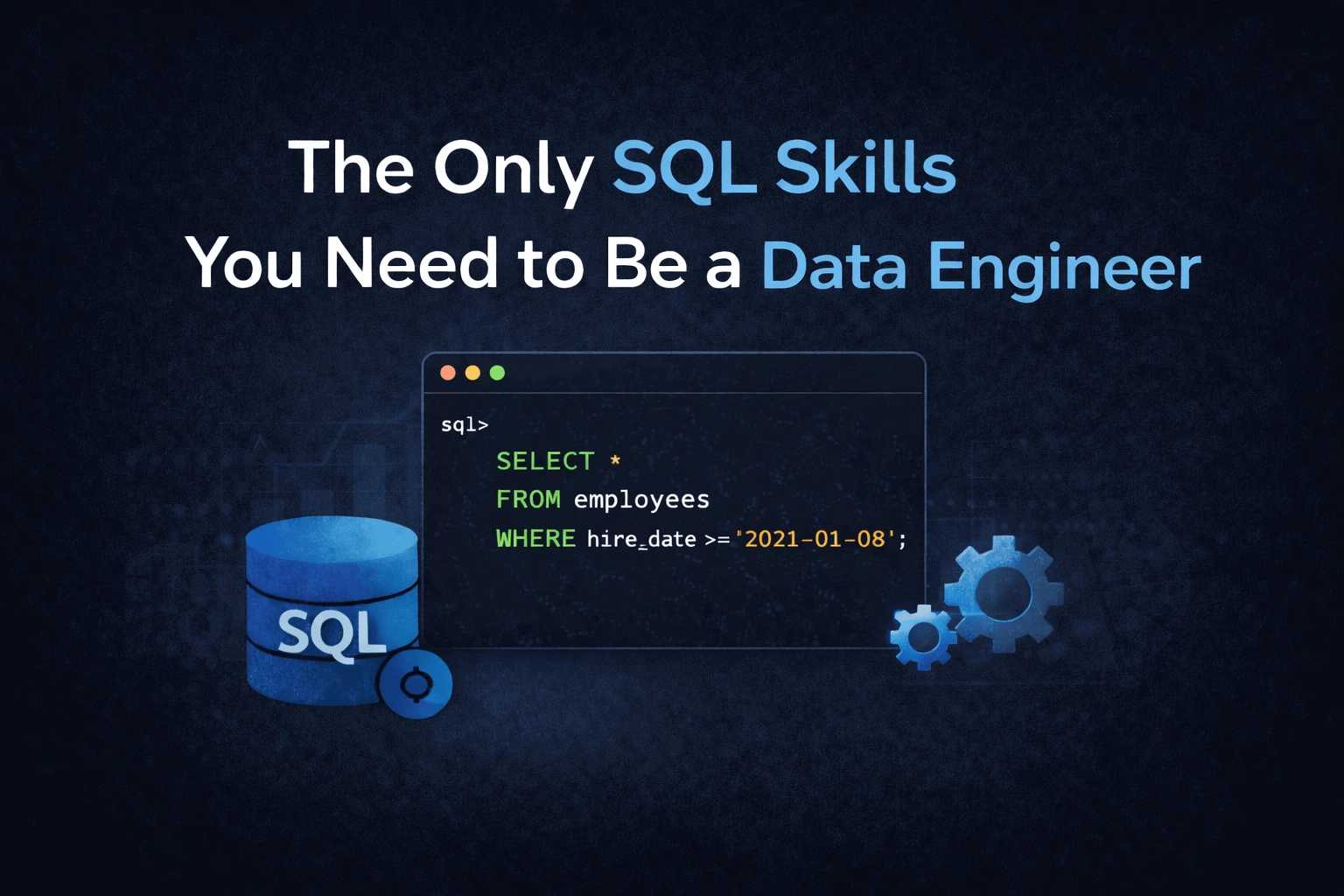
The Only SQL Skills You Need to Be a Data Engineer

On this page
SQL is the most important skill for a Data Engineer.
Python is great, but SQL is the language of data. If you cannot write good SQL, you cannot be a Data Engineer.
But you do not need to know everything. You do not need to be a Database Administrator. You just need to know how to transform and move data.
Here is the exact list of SQL topics you need to master to get hired.
Part 1: The Foundation (Retrieving Data)
Goal: Getting the data you want.
These are the commands you will use every single day. You must be able to write these without looking them up.
Basic Queries:
SELECT,FROM,WHERE,ORDER BY,LIMIT.Filtering: Using
AND,OR,IN,BETWEEN.Aggregations: Summarizing data using
COUNT,SUM,AVG,MIN,MAX.Grouping: Using
GROUP BYandHAVINGto categorize your results.
Part 2: Cleaning Data (Transformation)
Goal: Fixing bad data.
Data is never clean. It always has spelling mistakes, missing numbers, or weird formats. As a Data Engineer, your job is to fix this.
Handling Nulls: Using
COALESCEto replace empty values with a default (like 0).String Fixing: Using
TRIM(remove spaces),UPPER/LOWER(fix capitalization), andSUBSTRING.Logic: Using
CASE WHENstatements. This is your "If/Else" logic in SQL.Example: "IF price is null THEN set price to 0."
Date Functions: Using
DATE_TRUNCor formatting dates.
Part 3: Combining Data (The "Merge")
Goal: Bringing data together.
You will rarely look at just one table. You need to join data from different sources (like "Customers" and "Orders").
Joins: You must understand the difference between
INNER JOIN,LEFT JOIN, andFULL JOIN.Tip: 90% of the time, you will use Left Joins.
Unions: Combining two lists into one long list (
UNIONandUNION ALL).
Part 4: The "Engineer" Level (Advanced Logic)
Goal: Solving complex problems.
This section separates the beginners from the pros. These tools make your code cleaner and faster.
Window Functions:
ROW_NUMBER()andRANK(): Useful for removing duplicates (deduplication).LEAD()andLAG(): Useful for comparing today's data with yesterday's data.
CTEs (Common Table Expressions):
Stop writing messy "Subqueries" inside other queries. Use
WITHstatements to make your code easy to read.
Part 5: Building Structures (DDL & DML)
Goal: Creating the system.
This is the big difference between a Data Analyst and a Data Engineer. Analysts only read data. Engineers create tables and insert data.
Creating Tables:
CREATE TABLEandDROP TABLE.Changing Data:
INSERT,UPDATE, andDELETE.Upserts (MERGE): How to update a row if it exists, or insert a new one if it doesn't.
The Skills Checklist
Can you do everything on this list?
1. The Basics
[ ] I can Filter data using
WHERE,IN, andLIKE.[ ] I can Aggregate data using
GROUP BY.
2. Transformation
[ ] I can fix
NULLvalues usingCOALESCE.[ ] I can write
CASE WHENlogic.[ ] I can format Dates and Strings.
3. Advanced Logic
[ ] I understand
LEFT JOINvsINNER JOIN.[ ] I can use
ROW_NUMBERto find the "latest" record.[ ] I use CTEs (
WITHclause) to keep my code clean.
4. Engineering
[ ] I can
CREATEa new table.[ ] I can
INSERTdata into a table.[ ] I know when to use an Index to make a query faster.
Summary
Focus on writing Clean Code (CTEs) and Efficient Logic (Window Functions).
If you can take messy raw data, clean it with SQL, and insert it into a new table, you have the skills of a Data Engineer.