Grounding Agentforce: Why the Salesforce + Informatica Merger is the Key to Hallucination-Free AI

On this page
Grounding Agentforce: Why the Salesforce + Informatica Acquisition is the Key to Hallucination-Free AI
In the enterprise AI landscape, 2026 has become the year of the autonomous agent. Leading this charge is Salesforce with Agentforce, a platform that promises to deploy digital workers to handle customer service, sales operations, and complex workflows. But as any enterprise leader knows, an AI agent is only as intelligent as the data it can access. Without a solid data foundation, autonomous agents risk hallucinating, leading to critical compliance errors, poor customer experience, and lost trust.
This is where Salesforce’s landmark acquisition of Informatica—officially completed on November 18, 2025—proves to be the ultimate game-changer. By combining Salesforce’s agentic frontend with Informatica’s industry-leading data management, cataloging, and governance capabilities, enterprises can finally ground their AI models in a single, trusted version of truth.
In this post, we’ll explore how this integration works, why it is essential for eliminating hallucinations, the role of the new Model Context Protocol (MCP), and what it means for the future of enterprise data architecture.
The Enterprise AI Bottleneck: The Context Gap
Most enterprise AI failures are not due to weaknesses in large language models (LLMs) like GPT-4 or Claude 3.5. Instead, they stem from a lack of "situational awareness" or the context gap. When an Agentforce agent is tasked with resolving a customer billing dispute, it needs to access:
- CRM records in Salesforce
- ERP transaction logs in SAP
- Historical billing tables in Snowflake
- Product catalog data in an on-premises database
In standard systems, this data is siloed, inconsistent, and unstructured. If the AI retrieves duplicate customer profiles or outdated transaction logs, it will generate incorrect answers. For autonomous agents to succeed, they need a governed semantic layer that cleans, unifies, and delivers this data in real time.
How Informatica IDMC and MDM Unify the Data Layer
Informatica’s Intelligent Data Management Cloud (IDMC) and Master Data Management (MDM) solve this problem by creating a "golden record"—a single, deduplicated, and verified profile of any business entity (such as a customer, product, or asset). Under Salesforce’s ownership, Informatica has unbundled its stack to offer "headless" data management services directly within the Salesforce ecosystem.
When an Agentforce agent queries customer data, it doesn''t query a fragmented database. Instead, it interacts with an Informatica-governed data catalog. IDMC automatically verifies data quality, applies lineage tracking, and enforces data governance rules. This ensures that the context provided to the LLM is 100% accurate and fully authorized, effectively eliminating data-related hallucinations.
Model Context Protocol (MCP): The Technology Bridge
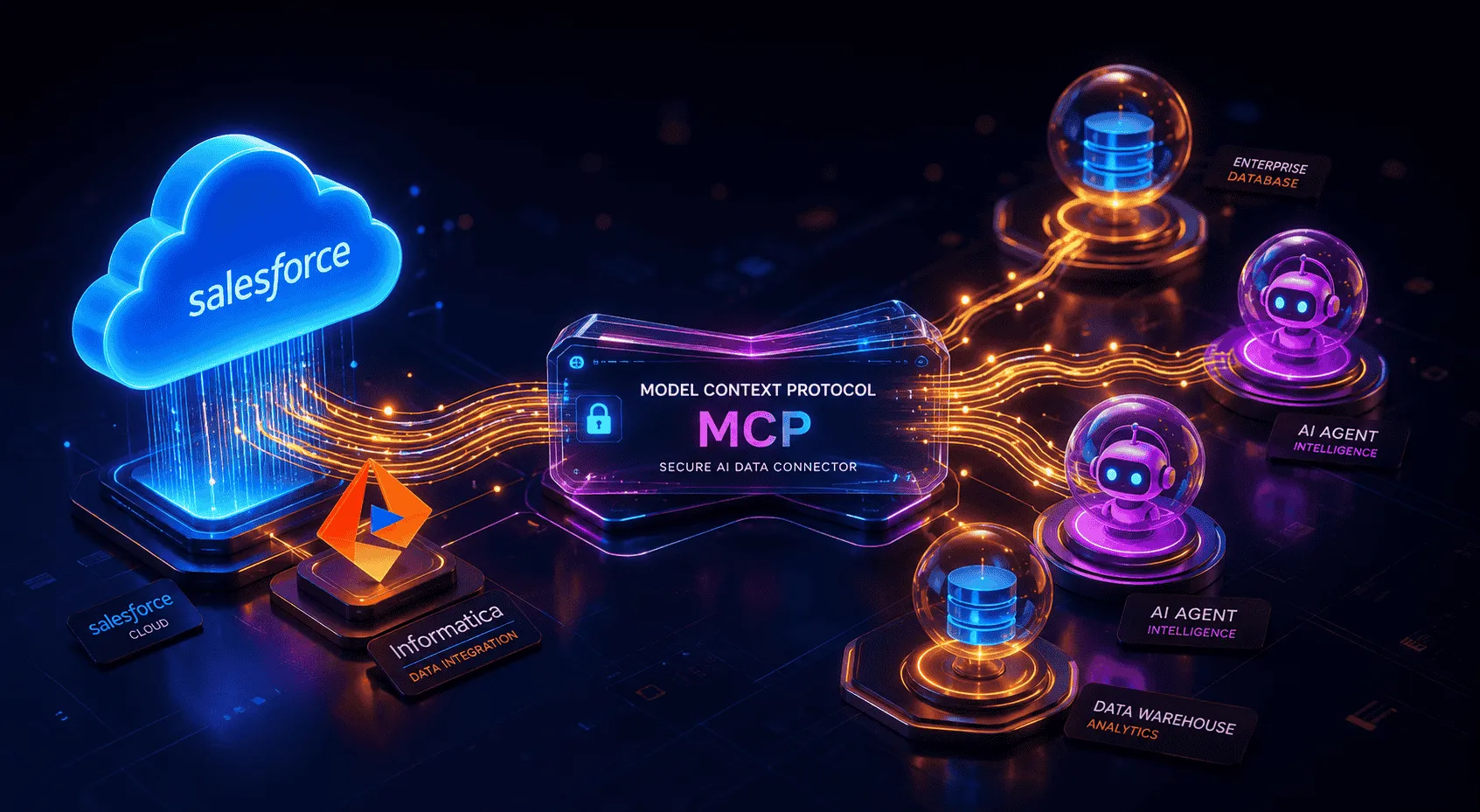
A key standard enabling this seamless integration is the open-source Model Context Protocol (MCP). Often described as the "USB-C for AI connectivity," MCP acts as a standardized communication layer between LLMs/AI agents and enterprise data sources.
Rather than building custom API connectors for every database, Informatica IDMC exposes its data governance, catalog, and MDM tools as MCP servers. Agentforce agents, acting as MCP clients, can instantly discover and invoke these services. This allows agents to dynamically fetch "Trusted Context"—including data lineage and business definitions—ensuring that every decision is backed by verified metadata.
This agentic design is a massive step forward. Just as we have witnessed the rise of autonomous development with CLI-first AI coding agents, enterprise AI is shifting from simple text-generation plugins to fully autonomous agents that execute complex multi-system workflows.
Practical Strategies for Enterprises to Build Grounded Agents
For organizations looking to deploy hallucination-free Agentforce agents, a structured data strategy is required:
- Unify Core Domains: Implement Informatica MDM to clean and consolidate customer and product records, building a reliable foundation of golden records.
- Catalog and Tag Metadata: Use IDMC to map data lineage, classify sensitive information (like PII), and tag data assets so the AI agents can easily understand where data originates.
- Expose Governed Data via MCP: Deploy MCP servers on top of your Informatica data services to allow Agentforce to pull context dynamically and securely.
The Upskilling Path: Opportunities for Data Administrators
This integration is also redefining career paths. The era of managing static, on-premises ETL pipelines is giving way to multi-cloud data orchestration. Developers and database administrators who bridge the gap between business CRMs (like Salesforce) and enterprise data stacks are commanding top-tier salaries.
If you are a database professional or Informatica developer looking to transition to this new cloud-native, AI-driven paradigm, preparing for the shift is essential. Check out our comprehensive Informatica Admin Interview Preparation Guide to learn the core differences between legacy PowerCenter and cloud-based IDMC architectures.
Conclusion: The Rails and the Engine
AI is only as good as the data it is grounded in. In this new era, Informatica provides the rails of data quality, cataloging, and master data management, while Salesforce provides the engine of engagement and agentic execution. Together, they represent the key to unlocking safe, reliable, and hallucination-free enterprise AI.